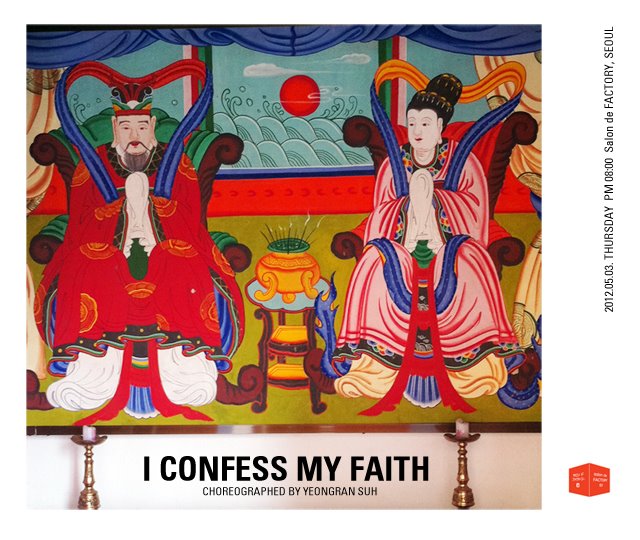
(Poster Design by Salon de Factory)
Introduction
How does ‘Shamanism’ live in modern Korean society?
After knowing that traditional shamanic village rituals are disappearing, a choreographer, Yeong Ran Suh, visited various villages along the Han River, where shamanic village rituals still continue in Seoul. The memories and stories of old villagers about their village’s shamanic tradition were deeply intertwined with their life experiences and the histories of the last century, including the Japanese Colonial era, the Korean War, and rapid industrialization.
 .
.
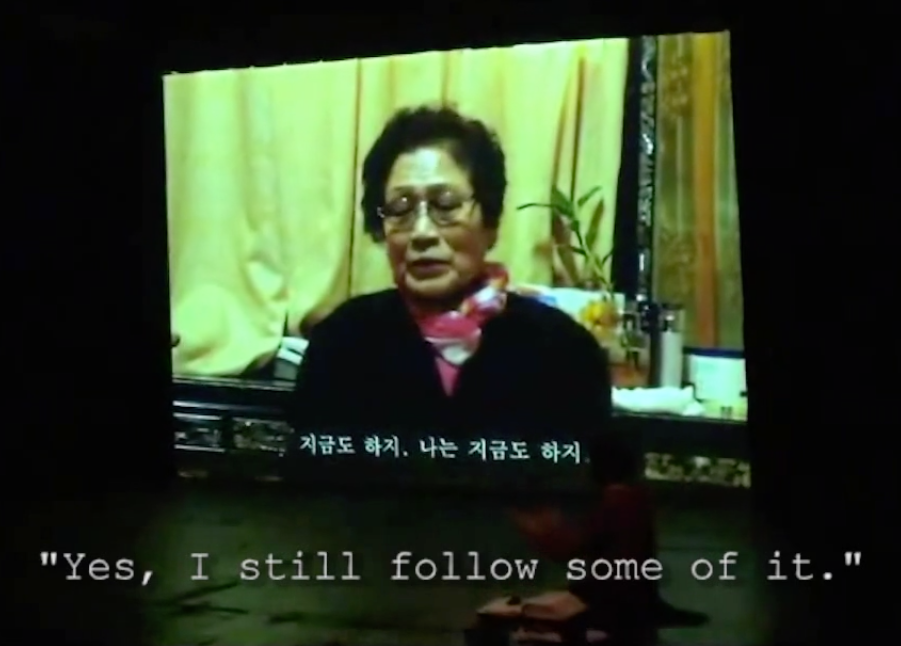
Korean shamanism was ostracized by urbanization, industrialization, and by the epistemological discrimination of Coloniality, Modernity, and Protestantism. Korean Shamanism was attested around the boundary of inferior belief, superstition, ancestral tradition, and religion. This lecture performance intertwines and reinterprets the stories of Korean elderly people and their shamanic beliefs, attempting to embody them through the dancer’s body, embodying the elderly voices, Korean shamans’ practices as a dancer’s body, and juxtaposing shamanism and Christianity.



Credit
Concept, Choreography, and Performer: Yeong Ran Suh
Interviewees: Hyun Taek Han (Gongdukgoal), Seung Sung Song (Dangsandong), Jong Sun Kim (Banghakgotji), the woman ( Banghakgotji Elderly Center), Jeong Ja Suh
Film and Operation: Na Yoon Heo, Ji Won Yoon
Film Edit: Seung Chan Woo
Presented by Nam Jun Paik Art Center (2011), Festival B:om (2012)
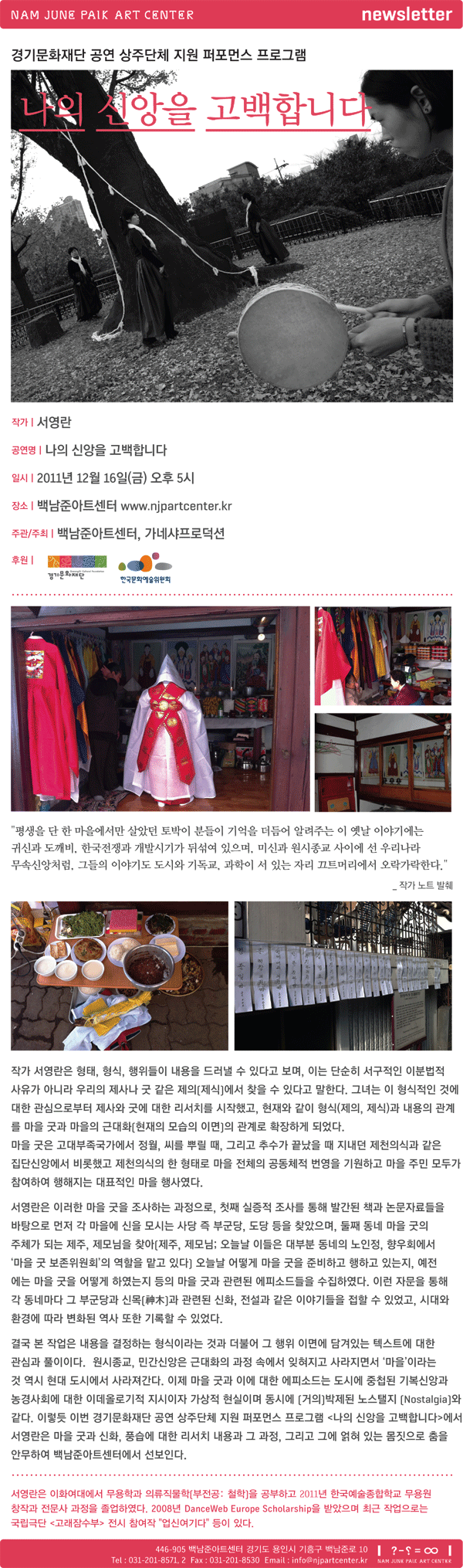
“Yeong Ran Suh expanded her interest in the relationship between form (rituals, practices) and content to the relationship between village shamanism and the modernization of the village…As ancient religions and beliefs are forgotten during modernization, the ‘village’ is also disappearing in the modern city. Now, the village shamanism and the episodes related to it are ideological instructions of the ‘faith for blessing’ and ‘farming society overlapped in the city’, virtual reality, and stuffed nostalgia…Suh choreographs and presents dances based on her research on village shamanism, customs, the research process, and gestures intertwined with them.”
(From the introduction written by Namjun Paik Art Center)
 yeongransuh.com
You must be logged in to post a comment.