Keyword: Care, Vegetal Being, Eco Feminism, Active Passiveness, Sympoiesis
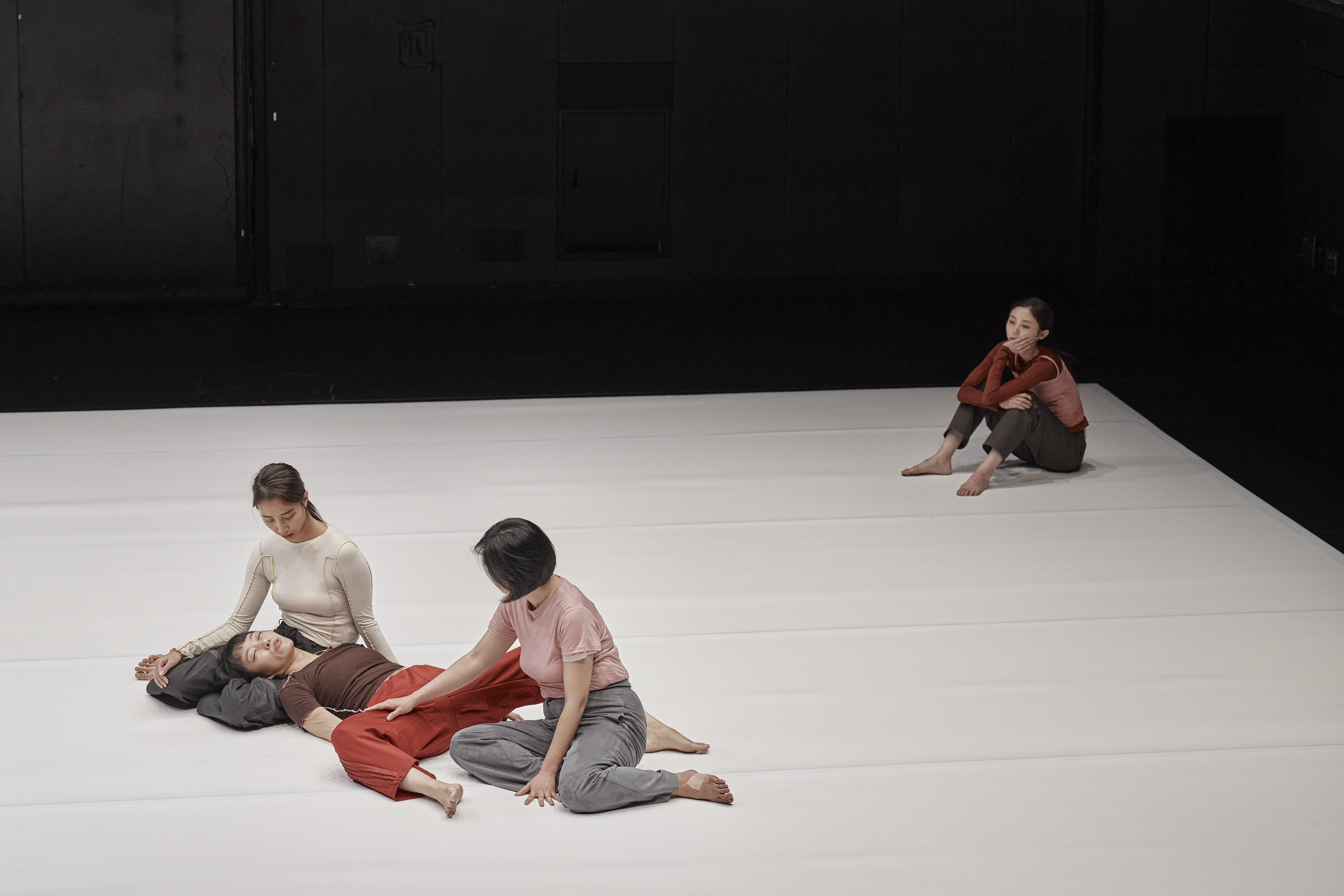
The Death of Vagina: Myth-making Voices started by rereading the myths of goddesses that have changed or disappeared in history. Metaphors of goddesses and exerted bodily mysticism in ancient tribes intertwined with contemporary women’s unconscious experiences. In this work, we see myths as communal stories, including questions about the lives & deaths, shifting away from the view that they are fixed heroic epics. Supposing that the myths of goddesses came to an end due to phallogocentrism, what should the next story be? Therefore, we attempt to imagine the future by co-overwriting on the ruins of past myths. This performance creates a regenerative space stimulated by intimacy, care, affected body and co-storytelling.
버자이너의 죽음: 신화를 만드는 목소리는 역사 속에서 변하거나 사라진 여신들의 신화를 다시 읽는 것에서 시작되었다. 고대 부족의 여신에 대한 은유와 신체 신비주의가 현대 여성의 무의식적 경험과 얽혀 있다. 이 작품에서 우리는 신화를 고정된 영웅서사로 보는 관점에서 벗어나 삶과 죽음에 대한 질문을 포함한 공동체적 이야기로 본다. 남근중심주의로 인해 여신신화의 종말이 왔다면, 다음 이야기는 어떻게 될까? 그러므로 우리는 과거라는 신화의 폐허 위에 공동으로 다시 쓰기를 하며 미래를 상상해 본다. 이 퍼포먼스는 친밀감, 돌봄, 영향받은 신체, 공동 스토리텔링을 통해 자극되는 재생적인 공간을 만들고자 한다.

CHOREOGRAPHER’S TEXT
The 2022 production of The Death of Vagina: Myth-making Voices not only carries on its premiere production in 2015, The Death of Vagina but also has differences. In the previous one, contemporary female performers told their stories about sexuality, unconsciousness and dream, bringing back the texts containing traces of Mother Earth and the mother goddess who had disappeared in a patriarchal conquest-oriented society and borrowing the language of a magical society that relieves the tension between women and men such as the “Phallic Mother” and the “Vagina Father.” Since then, Korean society has experienced intense waves of the #MeToo movement, and queer-feminist discourses dealing with differences in gender identity have continued.
Then in the 2022 version of The Death of Vagina, what can and should be discussed differently from its 2015 version?
Mythologist Wendy Doniger criticized that the categorization of mythological themes by Joseph Campbell, who wrote primitive mythology (that was directly quoted in the 2015 production of The Death of Vagina), was irrelevant. And she brought myths that had been veiled in all kinds of symbols and secrets along with heavenly gods and heroes to our earthly world and everyday lives.
Doniger says that myths cannot be classified according to the gender of myth writers: men or women. Even though mythological stories were often told and written by elite men, they would have also listened to the stories from their mothers or grandmothers. In addition, the questions that inspired the myths come from what many of us may have pondered over: “Why am I born with a female or male body?”“Why are menstruation and childbirth painful?” “What will death be like?”
The mythological stories which came down to earth are interwoven with the performer’s bodily experiences (unconsciousness, dream, reproduction and death), and the performers’ stories, that everyone has probably experienced once in their lives, connect to the stories of the audience. And the stories do not stop here. Did someone say that the climate crisis is a crisis of imagination? We would like to experiment to create myths and stories together and see if they can be continued. We have imagined a map which is in the process of being produced: the map on which the destroyed body of Mother Earth (predicting its destructive eruption), beings between male, intersex, female, bisexual and asexual, as well as post-coital and post reproduction in an era of cyborg, cloning, companion species and climate crisis are being created. Keeping this invisible map in mind, we intuitively sense and spread the branches of words. Finally, we hope the words heard and the bodies seen in this performance will be caught in the net of your own imagination rather than being interpreted or captured as information, enabling the grains of your stories to sprout.

CREDIT
Choreography : Suh Yeongran
Co-creators and Performers : Kwak Youha, Yum Joungyun, Yoon Sangeun, Jeong Eonjin, Jung Leesu
Sound Design : Kang Anna
Sound Technician : Hong Chosun
Light Design: Cho Myeonghwa
Costume : Kim Eunkyoung
Text Animation : Kim Bora
Movement Researcher Yoon Sangeun
Advisor : Kim Junghyun
Voice Coaching : Anita Baek
Script Translation : Lee Yun
Film & Edit: Swan
Text source quoted in caption *in quotation order :
Doniger. (1998). The implied spider: politics and theology in myth. Columbia University Press.
Pagels. (1980). The gnostic gospels. Weidenfeld and Nicolson.
Robertson, & Robinson, J. M. (1984). The Nag Hammadi Library in English (2.ed. ed.). Brill.
Campbell. (1991). The masks of God. Penguin


(All pictures © swan, KNCDC)
 yeongransuh.com
You must be logged in to post a comment.